Monday, July 29, 2013

JavaScript syntax checking

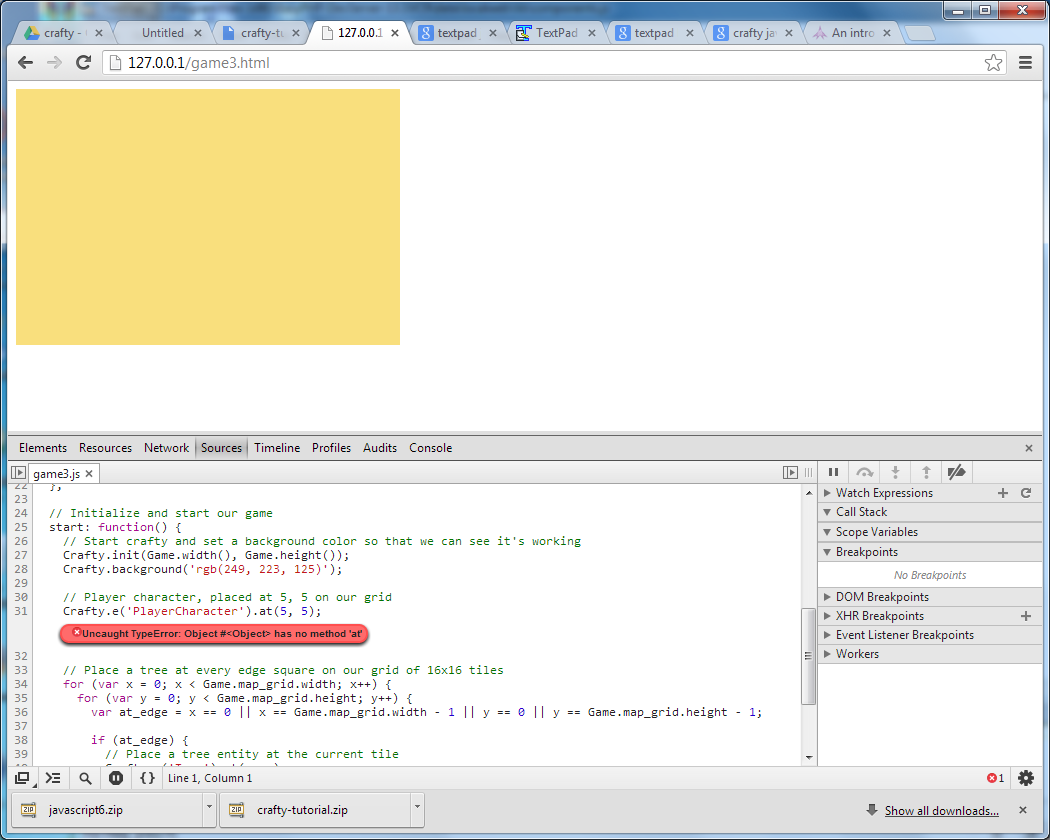
I was working through the Crafty tutorial on the fourth part, "Adding a player-controlled avatar," when I get the blank screen below.


By now I know this means there's a typo in the code, specifically, components.js. I learn the PlayerCharacter component on the website does not have a comma, not like the Bush and Tree components:

Crafty.c('PlayerCharacter', {
  init: function() {
    this.requires('Actor, Fourway, Color')
      .fourway(4)
      .color('rgb(20, 75, 40)');
  }
});

So I put on in after the inner closing curly brace, }. Then the game runs fine.

I realized I'm up the creek, so to speak, if Chrome is this sensitive. There's a high chance I'm going to make this mistake, too.

I search around and find JSLint, JavaScript Lint, etc. I tested on JSLint and it gave so many goggledegook messages and not the one to catch the above problem. After checking stackoverflow, I come to the Google Closure Compiler. The interesting thing is it finds three errors related precisely to the commas--namely, the commas shouldn't be there!

After I remove the commas in Tree, Bush, and PlayerCharacter, GCC is happy. However, the GCC is designed for improving code performance by rewriting the code. What I would really like is for a tool to take an html file and follow the links, checking each file in turn for syntax and semantics.

But not today.

Tuesday, July 23, 2013

JavaScript of my summer

I won't say that I had dismissed JavaScript. I simply had no use for it. Yet need is a b----. I had been working on PHP development the first half of the summer and out of curiosity, looked into JQuery, the utility of which I could appreciate. It's connection to Ajax is especially interesting. Along came Crafty and I was sold. It was the answer to Android's complexity for time which I did not have and simplicity which I sought. But no, what put JavaScript over the top was Underscore. I was in NYC yesterday and we went to the MoMA. If those Picasso's, Braque's, and Matisse's weren't elegant and simple and profound then...what is? I'm not saying Underscore is a masterpiece. I still don't know enough about it. However, on the surface it looks like one of the most interesting tools I'm come across since Scala.

Wednesday, July 17, 2013

jQueryMobile first look

I was going down the path of full-blown Android app development, which was not appealing for a few reasons.

First, I need a tool quick.

Second, Android app development is full of so much complexity. It's overkill. Whatever happened to the sample days of J2ME?

Third, Android apps are only for, well, Android.

Finally, using an Android app assumes you have the app. I can't see that working for the lost-and-found application too well. I mean, L&F is more likely to be a one-off sort of thing, not something a user will return to time and again unless they lost something.

Thus, jQM caught my attention.

I don't yet know enough about jQueryMobile except that it appears to go further than jQuery adding UI components in a cross-platform manner. This has plenty of advantages. It's disadvantages, of course, are 1) the app needs the browser, 2) the app looks like a browser, and 3) getting access to the sensors, the camera, GPS, etc. is uncertain. I read online that jQM don't have documentation as much as examples. I wouldn't hold this against jQM for examples may be all one needs.

jQuery first thoughts

Thanks to this tutorial I was able to spin up fairly quickly on jQuery. So now that I have some idea what it is about, I can see why some programmers swear by it. As a design pattern, jQuery appears to do exactly what its name implies: "query" and update the DOM more efficiently in LOC than JavaScript alone. I think that's about the gist of it.

Going further, it's kind of like assembly language for the DOM. I say this because, as an outsider looking in, I don't find jQ the most readable language I've used. $ for the jQuery constructor? $("#divA") finds divA? What can I say? It works.


Saturday, July 13, 2013

Ajax -- a first look

Here is a technology I had heard much about for years, especially after it was first released in the late 90s. Having taken a closer look at it, I can see its promise but also it curse. It is now clear that popular travel website like Orbitz, Travelocity, etc. probably use some sort of Ajax while the server searches for booking information. This is good.

However, the 'A' stands for "asynchronous"  and from a programmer's perspective that does not spell relief but pain. Multi-threaded programming is by far the most difficult programming, fraught with all manner of hazards, and Ajax is apparently no different.

That aside, there's the complexity of set up / configuration. Then parsing the response. Then, deciding the basic question of when to call upon all of this complexity.

Users will wait, not forever, of course. However, personal experience suggests that only as a last resort, when all else fails, use asynchrony. Otherwise, avoid it. The system will be more stable and predictable.

Sunday, July 7, 2013

Android edvelopment and XML

The prevalence of XML in Android development is a mystery: strings.xml, styles.xml, AndroidManifest.xml, one XML file per activity. It all seems anachronistic, to say nothing of error-prone and unwieldy. Eclipse can automate this and perhaps it does. We'll have to see.

Thursday, July 4, 2013

Nexus 7

The device arrived on 21 June. It took me about a week to open it, which was just as since the cover arrived about that time.

My first impression is that the Nexus 7 is not an iPad mini. The 7 has a smaller screen and is not as thin. Even the rubber case is not as slick as the magnetic one that protect the mini.

My first goal was to boot it up. Android is rather colorful and I will admit, more so than iOS.

My second goal was to deploy an app, just plug and go, I had hoped. But not so fast on the Mac which did not recognize it. So I plugged the 7 into my Windows machine and the same thing.

Evidently, the 7 needs some special developer tricks (like tapping the screen 7 times) and drivers.

The latter took me on a world-wind tour that led to the Nexus Root Toolkit, uninstalling drivers, and installing drivers. I doubted it would work yet it did!

Furthermore, when I plugged the device into my Mac, that worked, too. The Mac needed not extra software so I can only assume the NRT must have been installed some drivers and reconfigured the 7, too.

Thus, I've successfully deployed two apps from Android/Eclipse to the 7.

In summary, from a hardware POV, the mini wins hands down. However, from a software development POV, being an iOS developer, I don't see how Apple can win this battle with Google.


Thursday, June 27, 2013

JavaScript debugging in Chrome

This seems to me more natural. The only trick was finding the source lines: (three bars on upper right of Chrome) | Tools | Developer tools | Sources | "|>" | file name.

This makes eminently more sense with EclipsePDT than Aptana. EclipsePDT can transfer all the files to the web server and single-step PHP. Then let Chrome single-step the JavaScript. Actually I haven't tested the PDTEclipse-Chrome solution all the way through but each piece works separately. I'll need to integration test them

JavaScript on Aptana

I looked for a way to first write JavaScript in an IDE. I found Aptana which looks like Eclipse with the Aptana plugin pre-installed. It's a lovely concept, providing JavaScript (and PHP) syntax highlighting and intelli-sense (or what it is called when you hit "."). The problem with Aptana is I see how to debug JavaScript in it. I mean, why would I want to do that anyhow where there is Chrome debugging of JavaScript?

Wednesday, June 26, 2013

Curious JavaScript form validation

Here are two curios things about JS: 1) need for "return" for onsubmit attribute and 2) anything but "false" is accepted as "true".


<!DOCTYPE html>
<html>
<head>
<script>
function validateForm()
{
var x=document.forms["myForm"]["fname"].value;
if (x==null || x=="")
  {
  alert("First name must be filled out");
  return false;
  }
}
</script>
</head>

<body>
<form name="myForm" action="demo_form.asp" onsubmit="return validateForm()" method="post">
First name: <input type="text" name="fname">
<input type="submit" value="Submit">
</form>
</body>

</html>

Tuesday, June 25, 2013

Oh...JavaScript

I'm breezing through JavaScript and came upon this notation:

person=new Object();
person.firstname="John";
person.lastname="Doe";
person.age=50;
person.eyecolor="blue";

Now this strikes me as one of those error-prone sorts of things that hazardous for PHP: creating object fields on the fly.

Monday, June 24, 2013

PHP vs. Javascript for input validation

I've just moved into Javascript, the first day, and found probably the only piece of Javascript I really need for now. Namely, input validation.

But PHP can also do input validation as the code below suggests.

<!DOCTYPE HTML>
<html lang="en">
<head>
<meta charset="UTF-8">
<title>PHP Form Validation</title>
</head>
<body>


<form action="valid_handler.php" method="POST">
<fieldset>
<legend>Enter a quantity and email address</legend>
<p>Quantity : <input type="text" name="quantity"></p>
<p>Email Address : <input type="text" name="email"></p>
</fieldset>
<p><input type="submit" ></p>
</form>
</body>
</html>

The same (sort of) thing in JavaScript is:
<!DOCTYPE html>
<html>
<body>
<h1>My First JavaScript</h1>
<p>Please input a number.</p>
<input id="demo" type="text">
<script>
function myFunction()
{
var x=document.getElementById("demo").value;
if(x==""||isNaN(x))
 {
 alert("Not Numeric");
 }
}
</script>
<button type="button" onclick="myFunction()">Click Me!</button>
</body>
</html>

Without the benefit of other, more informed PHP-JavaScription opinions, I opinion is JavaScript is better to attempt this than PHP. Why? Because as a general rule, we prefer to do input validation as close to the source as possible. Rather than waiting for the HTML to get to the server, test it in the browser, save Internet latency, and conserve server cycles for when they are really needed.

Off by one errors

I received a phone call this morning from my step-mother. It wasn't even 8 AM and I assumed it was bad news, in this case, about my father. No, the flight reservations I had made for them in February had a bug. The conference they were attending ended on 18 Jul which was the date of departure. But they needed to depart on 19 Jul to make that last day of the conference.

I assumed I had gotten it wrong; rather, this departure date was the info she had given me. I know this because she told me today that she had also made the hotel reservations herself for the same (buggy) departure date. I didn't think at the time to ask about this last day. Then, it occurred to me, this is a boundary condition and an off-by-one-error.

Computer science is probably the formal place where I learned about off-by-one-errors. They come in the form of algorithm flaws and most notably crashes or "array bound exceptions."

I suspect these OBO errors are everywhere in life and the way we deal with them is the same way. If we catch them by testing beforehand, we're not lucky, just diligent. Indeed, there's a methodology called "boundary value analysis" for identifying such bugs. Even if we're diligent, we could still be unlucky. That is, we'll get an exception and deal with it in LA and worse, the day of departure.

Monday, June 17, 2013

LOC and complexity

Conventional wisdom, and dare I say "common sense," says that LOC and complexity are highly correlated. See here. The early data I'm getting for Scala and functional programming suggests there may, MAY, be more to this story. Maybe.

Tuesday, June 11, 2013

Primary, unique, and key constraints

The following query creates a primary key for the id column:

CREATE TABLE IF NOT EXISTS products
(
  id INT UNIQUE AUTO_INCREMENT ,
  code INT NOT NULL ,
  name VARCHAR(25) NOT NULL ,
  quantity INT NOT NULL ,
  price DECIMAL(6,2) NOT NULL
) ;

So the question is does every unique column a primary key? No.

The reason is the primary key is a type of unique column. A more complete explanation is here.

Monday, June 10, 2013

PHP and JSP

As I have moved further into PHP programming, I'm getting a feeling as to why PHP is so popular.

I, for one, cannot see much difference between PHP and JSP except for one thing: it's PHP and not Java. Duh.

PHP does not have THE "accident" of Java, namely, needing to specify types. PHP uses dynamic typing, that is, the type depends on the context. Part of the problem here for Java is that it is not a scripting language but may need to be one for JSP.

Whereas Java was ready for the Internet when it burst on the scene some 20 years ago, PHP is ready for the web server. Super globals like $_FILE and $_POST, associative arrays, etc. -- all these things seem to make PHP more productive than Java.

JSP and servlets were after-thoughts for Java as an alternatives to Perl and CGI--or at least that's my memory of things. With garbage collection and simple inheritance, Java was definitely an advance over C++ for the tasks for which it was designed. In the same spirit, PHP seems to me an advance compared to Java for server side programming.

And I haven't even gotten to the database tie-in which I'm just about to take up in my learning.

Sunday, June 9, 2013

Eclipse PDT

As I have written earlier, modern software development for me is to automate the "accidents" of computing to reduce errors. Toward this end, I had installed NetBeans which worked beautifully with PHP. However, I failed to get NetBenas to work with IDE debugging of PHP scripts. It was hugely disappointing because NB came with a recommendation and I liked the refactoring of PHP variables. I wasn't crazy about how NB ran the script in the browser window instead in the IDE window but...nobody is perfect.

Thus, I abandoned NetBeans on the Mac and instead installed Eclipse PDT and EasyPHP on Windows 8. I still struggled a bit but managed to get single-step debugging working.

The trick is to put the project on the local server. Unfortunately there are no instructions as to how to do this. Yet after floundering around, I found the option under Preferences | PHP Servers which positions all project scripts under the web server root. Once that is set up, Eclipse will breakpoint every time at the first statement of the PHP script (this is configurable, I believe) and furthermore, the web page displays in the Eclipse IDE.

Variable inspection is available as well as variable inspection.

Unfortunately, Eclipse PDT does not do refactoring except for the script as a whole.

Saturday, June 8, 2013

An elemental Scala parser

I've been writing a parser for Scala to gather complexity information. It doesn't need to "compile" Scala, just extract method information. Thus, I'm duly impressed that anyone could possibly parse Scala, given the difficulties and doubts I have that I've gotten it right. Indeed, some people seem to think that one cannot write a parser for Scala without, in effect, running it to compute the types and sort out implicits. However, as I was cleaning house, I came across an CACM article, Inexact Design--Beyond Fault Tolerance. It deals with hardware but nevertheless struck me as a cool idea, that is, of "inexact," "probabilistic," or "approximate" computing. I think that's kind of what my Scala parser is doing.

Wednesday, June 5, 2013

PHP class properties

The possibility of dynamically creating new properties in a PHP class seems like a slippery slope. Nixon (2012) says to avoid it because of the potential to create bugs. I agree. Then, why is the possibility there. A programming language's job, among other things on the path of automation, is to automate the detection and elimination of errors.

Tuesday, June 4, 2013

PHP super class constructors

In C++, Java, and Scala, instantiating an object automatically invokes the parent class's constructor. Not in PHP 5. Instead you have to invoke it yourself. I am surprised. This potentially a huge source of awful errors.

And for a silly reason because PHP creators couldn't put in the automatic invocation? Is there some other explanation?

Then again, Obj-C doesn't automatically invoke it's parent constructor. I've been waist deep in Obj-C for the past few years and while I won't say that never caused a problem, I've had far bigger issues with Obj-C (e.g., not crashing when accessing uninitialized variables).